Rolf Schick (1933 – 2026)
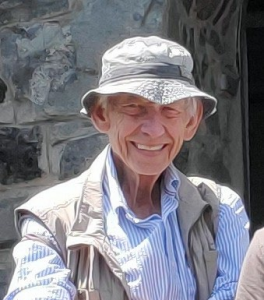
Rolf Schick, born June 2nd , 1933, a Professor Emeritus of geophysics from the University of Stuttgart, Germany, passed away after a brief illness on March 13th , 2026, at the age of 92. Rolf was a well-established member of the geophysical and seismological communities in Germany and beyond, and a pioneer of volcano seismology. He will be fondly remembered by all who knew him for his enthusiasm, curiosity, imagination, and for his ability to combine what he liked most: seismology, especially of volcanoes; teaching; wine and good food; ham radio; tinkering; travel; and his family.
When he was 15 years old, Rolf earned and received one of the first ham radio licenses issued in Germany after World War II, having built his own receiver using schematics from an encyclopedia. Over the following more than 70 years, he continued his QSOs (radio conversations) via voice and Morse code, participating in and contributing to the growth of ham radio in Germany. In later years, when the radios had become more compact, they accompanied him on all his travels. In the evenings after scientific meetings or field work, and the obligatory social and scientific discussions, Rolf often spanned his antenna, tested the airwaves and collected new QSOs. He claimed to “talk faster” via Morse code than voice, especially after enjoying a glass or two of wine.
Following his schooling, Rolf entered an apprenticeship to become a machinist, completing the courses as a journeyman. This experience was to serve him very well in dealing with the technical challenges of his later career in seismology. He completed high school maturation in the Fall of 1956 and immediately began to study physics at the Technische Hochschule Stuttgart, which later became the University of Stuttgart, and where he spent the rest of his career. Rolf was fortunate to be assigned to help and drive Frank Press, when he arrived in 1961 in Stuttgart to install the equipment for the World Wide Standard Seismograph Network (WWSSN) seismic station, STU, which was commissioned in January 1962. The combination of the technical and physics aspects of seismology that he encountered in this task is likely the impetus for Rolf to work with Prof. Dr. W. Hiller, the director of the State Seismological Service of Baden- Württemberg, later the Institute of Geophysics of the University of Stuttgart, where he completed his doctoral thesis. During the late-1960s, the Institute grew into one of the respected centers of geophysics in Germany due in part to Rolf’s contributions to the development new instrumentation, and his operation of the WWSSN station as well as the local and regional seismograph stations. His curiosity and enthusiasm often communicated itself to his masters and doctoral students.
Rolf’s research interests shifted during a vacation to Italy with his wife, Inge, an artist, in the late-1960s. They went in search of good food and beautiful surroundings near the volcano Etna on Sicily. There he also found volcanic tremor in the seismic recordings from the mountain, engaging his curiosity. Finding that there were few good physical explanations for the source of the volcanic tremor, he enthusiastically became a pioneer in volcano seismology and began working on the open questions with Italian geophysicists. Developing and exploring imaginative models for the tremor sources in evening discussions was an enjoyable and important aspect of his studies, with many publications resulting from the collaborative vetting and description of those models. He encouraged new connections by bringing German colleagues and students into his work on Etna volcano, and Italian colleagues and students to work with him at the Institute in Stuttgart. Later in life, he proudly related that some of the connections he had made across country borders resulted in marriages between Italians and Germans.
While his interest in volcanoes in Italy and other countries continued, Rolf also turned his gaze toward Indonesia. Based on a bilateral agreement between the German and Indonesian governments, and financing from the former, Rolf gave his whole-hearted support to a project beginning in 1982 and encompassing both technical and training aspects to improve the monitoring of Indonesian volcanoes, particularly Merapi, near the city of Yogyakarta, Indonesia. The program, to work on physical volcanology, centered on co-operation and collaboration between the University of Stuttgart and the Gadjah Mada University in Yogyakarta, Indonesia. It included the placement of German scientists and the establishment of a Masters program (S2) in Geophysics in Indonesia, as well as exchange between both institutions to encourage collaboration and joint research. As one of the scientists spending two years at Gadjah Mada, one of us (JN) experienced Rolf’s enthusiasm and charisma during his visits, and the motivating impact he had on the Indonesian project partners. The Masters program is still thriving, now in the competent hands of our Indonesian colleagues. Based on these contacts, a series of German – Indonesian bilateral research initiatives followed, as well as a European research program in which Rolf was involved, aimed at studying the volcanoes in Java and Bali.
Early on, Rolf began promoting the idea that seismicity on volcanoes is complex, that it provides a view into the volcanic processes, and that it should be a separate branch of seismology requiring study and especially discussion on its own merits. To encourage discussion, he and his colleague Bruno Martinelli, who worked in Colombia on the 1985 eruption of Nevado de Ruiz, established the ‘Working Group on Seismic Phenomena Associated with Volcanic Activity’ within the European Seismological Commission (ESC). Rolf led this working group until 1998 when he encouraged one of us to take over as chair. By then this group had developed into an international forum with annual workshops dedicated to seismic monitoring of volcanoes and the novel interpretation of volcano seismic signals during various stages of activity. The working group has now merged into the well-established Commission on Volcano Seismology and Acoustics, jointly hosted by IASPEI and IAVCEI. The annual, international workshops still bear Rolf’s unique signature, a friendly environment for open discussion and exchange of ideas as an alternative to large conferences. This ESC working group has also been instrumental in promoting the wider use of broadband seismic and infrasound equipment on volcanoes all over the world.
Rolf Schick leaves behind a text book well-known by some generations of German geophysics students; many articles and several monographs about volcanic tremor and seismology; a number of popular articles and books for the general public; group members from a few volcano tours he led to far-flung shores; and perhaps more importantly many students and colleagues inspired by his ideas, initiatives, questions and enthusiasm. His passion for volcanoes and particularly volcano seismology will be remembered fondly by many geoscientists who have had the privilege to work and interact with him. While Rolf’s legacy lives on, he will be missed by everyone who was fortunate enough to have known him.
Jürgen Neuberg, Commission on Volcano Seismology and Acoustics, Chair 1999 – 2025, Leeds University, UK Peggy Hellweg, Berkeley Seismology Laboratory, University of California Berkeley, U.S.A. With contributions from E. Wielandt, W. Zürn, W. Brüstle and H. Langer