Abdelkrim Aoudia (1968 - 2025)
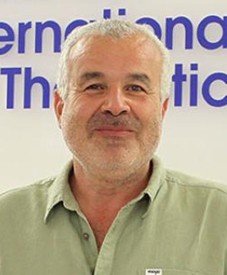
Prof. Dr. Abdelkrim (Karim) Aoudia was a senior researcher in geophysics, Director of Research and Expert at ICTP - UNESCO Trieste (the International Centre of Theoretical Physics, also ICTP Abdus-Salam, named after the Physics Nobel Prize winner in 1979). Karim passed away 57-year-old during the night 19 – 20 October 2025.
Dr. Aoudia’s initiation in geology and geophysics began at the University of Science and Technology Houari Boumediene (USTHB, 1987 – 1991) and at the Geophysical Centre of Algiers (CRAAG) from 1991 to 1994 in collaboration with Prof. Mustapha Meghraoui. He moved first to the ING Rome in 1994 – 95 for training in Seismotectonics, then to the University of Trieste to join Prof. Peter Suhadolç and Prof. Giuliano Panza and obtain his PhD in Solid Earth Geophysics in 1997.
Acting Head of the Earth System Physics Section of the ICTP, Coordinator of the Solid Earth Geophysics Research Group, and member of the faculty of the PhD Program in Earth Sciences, Fluid Dynamics and Mathematics, Interactions and Methods (ESFM) at the University of Trieste. In 2006, he founded the ICTP's pre-doctoral diploma in Earth System Physics, a one-year educational program for students from developing countries. He has supervised and co-supervised more than 20 doctoral students and organised more than 40 international summer schools, conferences and advanced workshops at the ICTP and in developing countries.
He targeted the understanding of earthquake generation and related processes by the integration of tectonic and geophysical data of geologically complex solid Earth system. His major contributions were in the mechanics of earthquakes and faults, the structure and rheology of the lithosphere, and the physics of crust-mantle interactions in seismic and volcanic regions, the physics of transient deformation and space geodesy, and physics-based seismic risk assessment. Among his contributions on the crustal and lithospheric deformation he took a keen attention to the study of major seismic events such as the seismotectonic framework of the 1922 Tenes earthquake (Mw 6.0), the 2003 Zemmouri-Boumerdes earthquake (Mw 6.8; where he became an advisor to the Algerian Presidency), the Friuli (1976), the Himalayas (2015), Central Apennines and Tyrrhenian Basin, and along the Dinaric fault in Slovenia (2019) are milestones of modern seismology.
Karim was also the ICTP focal point for several international associations and funding agencies such as: IUGG, IASPEI, AGU, KFAS, OFID, the Arab Fund, EU-Interreg, insurance companies (Generali and Zurich) and national development agencies.
The scientific institutions have lost a truly great humanitarian geologist and geophysicist.
Mustapha Meghraoui, University of Strasbourg